Showing posts with label rush. Show all posts

Tuesday, 6 September 2022

Woven seats in ancient Egypt (Part 2)

 Now here's a stool dating back to 1600 BC, from the 17th Dynasty. The wooden frame is tamarisk, and the seat is woven from rush. It's about 13cm high. That might seem quite low to us, who are used to much taller seats, but in ancient Egypt people were accustomed to sitting on the ground most of the time, so even a little stool like this would elevate you above everyone else. 

It seems to be quite a common pattern among seats of that vintage. So far as I can make out, the rush isn't twisted the way we'd twist rush for modern seats in the traditional rush pattern,  but it must be twisted a bit, in order to create those long fine strands. 

The rush is wrapped around the frame, and then looped back over itself (  See the stool I recently did  with cord, which is looped in a similar way. ) This creates a single-layer seat, unlike the stools we commonly make nowadays where we wrap the cord all the way round, underneath the seat, making an upper and lower layer (which takes more work, and requires more material!)

The other thing I notice is that there  don't seem to be any intermediate, short wraps round the frame in between the strands strands that cross the seat. (Though it's difficult to make out in this rather small photo. There might be single wraps in between.)

 It's a simple, but pleasing pattern, and I may try it with fine, ready-twisted rush on one of our 12-inch stools. Actually working the pattern would make it easier to see what the original seatweavers did.

But.... Isn't it wonderful to see such well preserved furniture from 3½ thousand years ago?  The dry conditions in Egypt helped to preserve such things of course, but I'm pretty sure our own ancestors weren't making pretty furniture back then.

Below is my take on the pattern. I haven't bothered to draw it all the way across the stool, but you can what I've done. Does it need intermediate wraps? I think it probably does, otherwise the loops would interfere with each other. Watch this space: I'll show you my experiments when I try to do it myself.


If you'd like to try it yourself, you can buy fine, ready-twisted rush from our website, here: Fine ready-twisted rush

Monday, 14 February 2022

THE RUSH SEAT

the rush seat

Evidence of rush seating turns up throughout history. The Vikings almost certainly used this method, and in mediaeval Italy simple rush-seated ladderback chairs were commonly used. Strangely, considering that the best rushes grow in England, there's no direct evidence of rush-seating in Britain before the 17th century, though it's quite likely it was used before this.

The pattern is simple, and must have been discovered numerous times by different people throughout history. It's simply a matter of creating a twisted rope of some local material, and wrapping it in a particular way around a wooden frame. You simply attach it to the inside of the frame, and work your way round, over and under, over and under, until you reach the centre of the seat. This produces a strong, but comfortable seat.

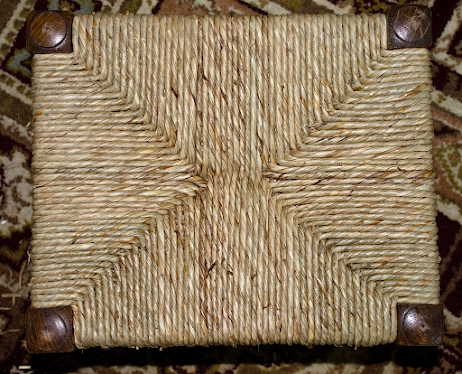
Above: stool seated with ready-twisted natural rush.

In the UK, the common bulrush, Scirpus lacustris, grows in the River Thames and various Norfolk rivers, and this is the plant used most of all in this country for rush seating. In the USA the leaves of the cattail plant are more usually used, and each country will have its favourite seating material. 

Anything that can be twisted into a rope can be used for this pattern. We often make seats in the rush pattern using seagrass, Danish cord, cotton cord and flax cord, and I've seen chairs made with brightly coloured nylon rope.

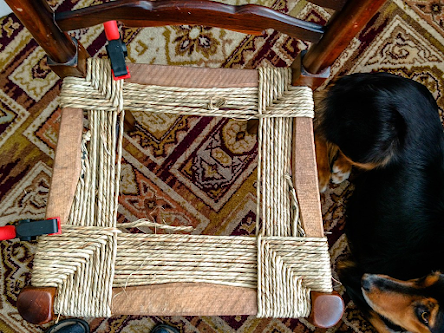
Above: a chair seat partly wrapped with rush cord. You can see the working end hanging loose in the middle. The next strand of rush will be tied to this, and the knot will be hidden inside as work progresses. We use plastic clamps to hold the rush in place as we work.

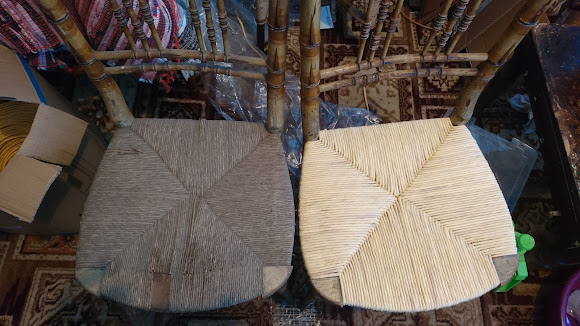
Above: two chairs from a set of four. The one on the left is still to be done, while the one on the right has been stripped down, cleaned and polished, and seated with paper rush.

You can find various materials suitable for the rush pattern on the e-commerce part of our website, SitUpon Seats Shop.

If you'd like us to reseat your chair, just send us an email to ally@situponseats.co.uk or give us a ring on 01900 813200.